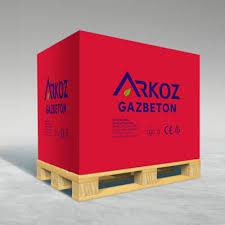
Construction Equipments
G3/500 Autoclaved Aerated Concrete ARKOZ GAZBETON
Technically, Autoclaved Aerated Concrete (AUC) belongs to the group of lightweight concrete materials that have undergone porous steam curing. It is a lightweight building material with low thermal conductivity, high strength, and low density. Its composition includes ground quartzite, gypsum, cement, lime, and recycled (AUC) materials (slurry and powder). Water and aluminum powder are added to the mixture and mixed until homogeneous. The resulting mixture is then poured into molds. The aluminum begins to react in an alkaline environment, and the resulting hydrogen gas creates pores within the mass, which escape without leaving any residue. The pores, typically 0.5 to 1.5 mm in diameter, are filled with air. After the cement begins to set, semi-solid raw blocks are formed, and after highprecision cutting, these blocks are used to produce building materials (AUC). The structural components reach their final shape after undergoing a steam curing process at approximately 190˚C and under approximately 12 bar pressure for 5-12 hours in units called autoclaves. The materials used are calcium hydrosilicate equivalents of tobermorite, a naturally occurring mineral. Once the reaction is complete, the material is autoclaved and gains its strength. Once cured, the steam generated is reused in subsequent autoclave cycles. The aerated concrete blocks are then stacked on wooden pallets and shrink-wrapped in polyethylene bags. Labeling and storage are then carried out.